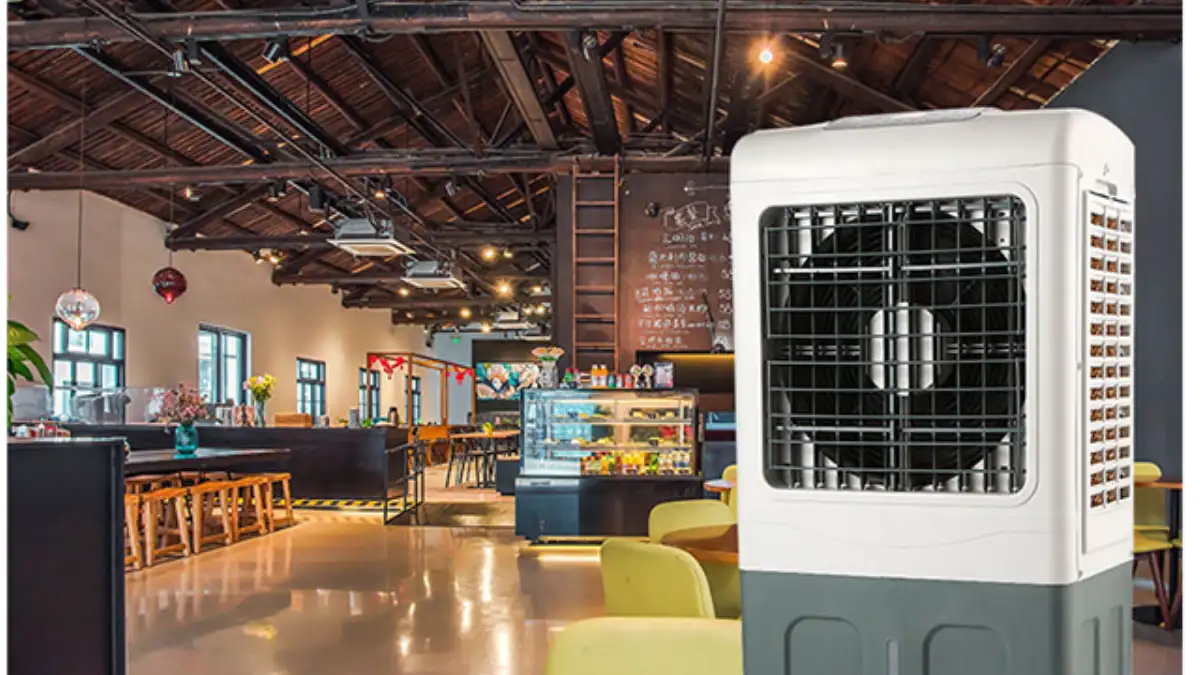
Selecting an air cooler without understanding key performance factors often leads to unstable cooling, 空気の流れが悪い, and unnecessary energy loss in real applications. Many failures are caused by mismatches between airflow capacity, cooling media quality, and environmental conditions rather than the product itself.
This article helps you understand the core engineering elements that affect cooling performance, including evaporative media efficiency, airflow and fan design, water system stability, and environmental limits. It provides a clear basis for comparing systems and choosing the right solution for stable, efficient operation.
How Air Cooler Cooling Performance Works

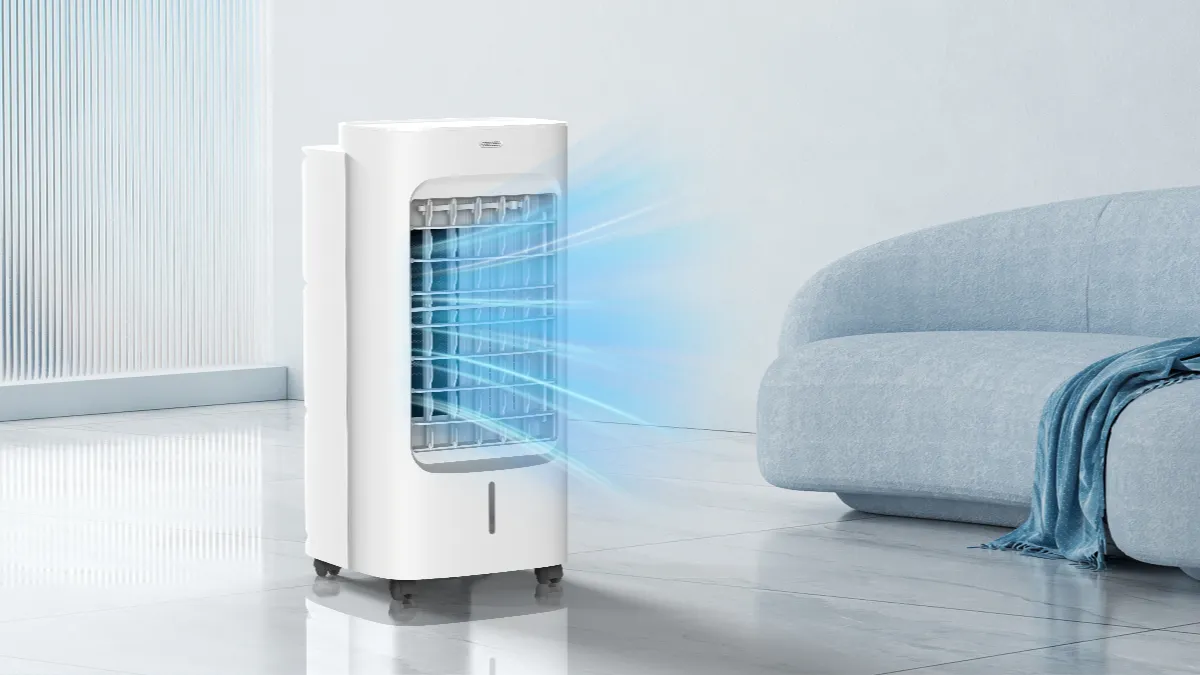
Air cooler performance depends on a continuous interaction between air movement, water evaporation, and heat exchange. Instead of relying on mechanical refrigeration, the system lowers temperature by using airflow to accelerate natural evaporation inside a controlled structure.
Cooling performance develops through three connected stages:
- Air intake stage: The system draws warm ambient air into the unit to initiate heat exchange
- Evaporation stage: Air passes through wet cooling media where heat transfers to water during evaporation
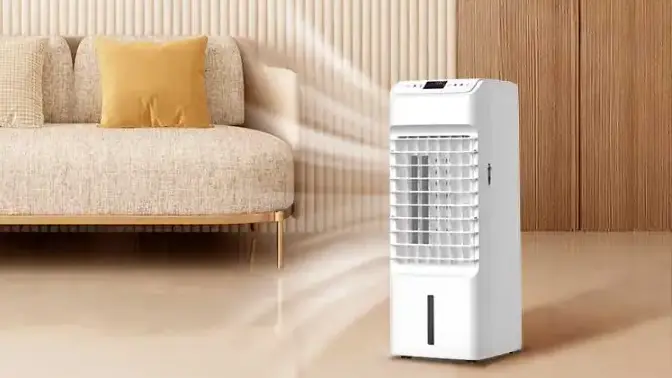
- Air delivery stage: A fan system pushes cooled, moisture-conditioned air into the target space
Warm air becomes cooled output only when these stages operate in balance. Any imbalance in airflow volume, water saturation, or ventilation reduces overall thermal reduction efficiency.
System behavior and performance control factors
| System Element | 関数 | Performance Impact |
|---|---|---|
| Airflow Structure | Controls the volume of air moving through the cooling media | Determines cooling coverage and airflow distribution consistency |
| Evaporative Interface | Facilitates heat transfer between airflow and the water film | Influences the maximum achievable temperature reduction |
| Water Circulation | Maintains uniform wetting across the cooling media surface | Supports stable and consistent evaporation performance |
| Air Exchange | Removes humid air and introduces fresh ambient air | Prevents humidity saturation and maintains cooling efficiency |
Cooling efficiency depends on how well the system maintains continuous air exchange. When airflow weakens or humidity accumulates, evaporation slows down, and the temperature difference between inlet and outlet air becomes significantly smaller.
You may be interested in: 冷却の説明: 空気冷却器の仕組み?
Evaporative Cooling Pad Material and Quality

Cooling pad design directly determines how efficiently an air cooler transfers heat from air to water. Differences in material structure, fiber density, and airflow resistance create significant performance gaps between systems, especially under continuous industrial operation.
High-performance evaporative media must balance two core requirements:
- Water absorption capacity: Supports stable and continuous evaporation
- Airflow resistance control: Ensures air can pass through without excessive pressure loss
Cooling media comparison in real applications
| Cooling Pad Material | 冷却効率 | 耐久性 | Maintenance Demand | Typical Application |
|---|---|---|---|---|
| Cellulose Pad | 高い | Medium to High | 中くらい | Industrial and commercial cooling systems |
| Plastic Media | Medium to High | 高い | 低い | High-humidity or heavy-duty environments |
| Aspen Fiber | 中くらい | 低い | 高い | Budget-focused or temporary cooling applications |
Cellulose media remains the most widely adopted option in modern systems because its cross-fluted structure improves air-to-water contact without creating excessive pressure loss. This balance is critical for maintaining stable cooling output in continuous operation.
Key engineering parameters affecting pad performance
- Fiber density control: Higher density increases water retention but may raise airflow resistance if overcompressed
- Flute geometry design: Optimizes the trade-off between evaporation surface area and pressure drop
- Surface treatment layer: Improves resistance to microbial growth and mineral scaling
- Structural stability: Prevents deformation and uneven wetting under long-term saturation
Water quality impact on long-term performance
Water conditions directly influence how long cooling media can maintain efficiency. Even high-grade pads will degrade faster when water is not properly controlled:
- Mineral scaling effect: Reduces open airflow channels and limits evaporation surface area
- Biological growth risk: Accelerates material degradation and reduces hygiene stability
- Chemical imbalance: Weakens fiber bonding in cellulose-based structures over time
Consistent water management extends pad lifespan and maintains stable cooling output, especially in high-load or continuous-use environments.
Boost Profits with Factory-Direct Air Coolers
Airflow System and Fan Design

Airflow performance directly defines how efficiently cooled air reaches the target space. Even when evaporation efficiency is stable, insufficient air movement or poor pressure matching will significantly reduce practical cooling effectiveness.
Airflow design is mainly controlled by two engineering parameters:
- Airflow volume (CFM): Determines the total amount of air delivered per unit time
- Static pressure (mmH₂O): Defines the system’s ability to overcome resistance from cooling media and ducts
These two values must work in balance. High airflow without pressure support cannot pass through dense media, while high pressure without sufficient volume reduces cooling coverage.
Fan type selection and system matching
| Fan Type | Primary Advantage | Main Limitation | Typical Application |
|---|---|---|---|
| Axial Fan | High airflow volume with low energy consumption | Limited ability to overcome airflow resistance | Open spaces and low-resistance cooling systems |
| Centrifugal Blower | Maintains stable airflow under higher static pressure | Higher power consumption and larger installation space | Ducted systems and high-resistance airflow paths |
| Cross-Flow Fan | Provides uniform airflow distribution across the outlet | Lower maximum airflow capacity | Compact units requiring consistent airflow coverage |
Correct fan selection is critical because system resistance changes depending on cooling media density, filter load, and airflow path design. A mismatch between fan type and resistance curve leads to unstable airflow and reduced cooling coverage.
You may be interested in: エアクーラーファンについて知っておく必要があるすべて
Key engineering factors affecting airflow efficiency
- Impeller size optimization: Larger impellers reduce rotational speed requirements, which helps lower noise and improve energy efficiency
- Blade geometry design: Controls airflow direction and reduces turbulence inside the chamber
- Motor technology selection: EC motors improve efficiency and allow precise speed control under variable load
- Airflow path design: Smooth internal channels reduce resistance and prevent energy loss from turbulence
When airflow design is not properly balanced, the system may still operate at full power but fail to deliver effective air distribution, especially in large or obstructed spaces.
Water System Efficiency and Pump Performance

The water system directly controls the stability of evaporative cooling by regulating how consistently water reaches the cooling media. When water flow becomes unstable, evaporation efficiency drops immediately, leading to uneven cooling output and reduced system reliability.
Stable performance depends on continuous coordination between circulation, distribution, and storage functions.
Core water system architecture
- Pump system: Drives continuous water circulation through the loop
- Distribution network: Delivers water evenly across the cooling media surface
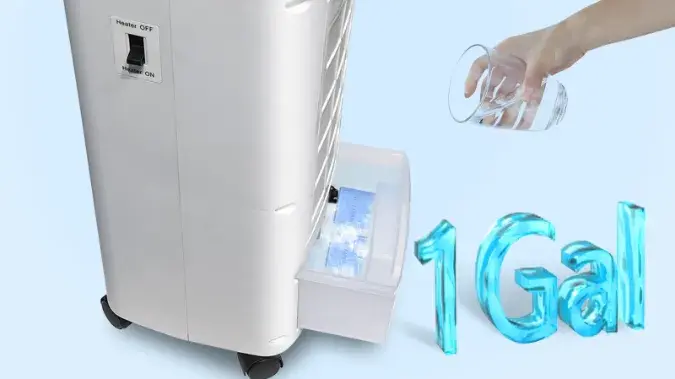
- Storage tank: Maintains sufficient water volume for uninterrupted operation
- Filtration unit: Reduces impurities that can block or damage internal channels
These components work as a closed loop. If one part becomes unstable, the entire cooling process loses consistency.
Key performance control factors
- Flow stability control: Maintains continuous wetting to avoid dry zones on cooling media
- Distribution balance: Prevents uneven saturation that reduces effective evaporation area
- Air intrusion control: Eliminates trapped air that weakens pump efficiency and disrupts flow
- Capacity design: Ensures sufficient water volume for long operational cycles without interruption
Each factor directly affects how uniformly the cooling media performs under continuous load conditions.
Common system performance issues
- Inconsistent pump output that reduces circulation stability
- Uneven wetting patterns across cooling pads
- Mineral deposits that block internal water channels
- Air lock formation in the circulation loop
These issues usually develop gradually and often appear as reduced cooling efficiency before mechanical failure occurs.
Proper system layout is also critical. If air accumulates near the pump or inside the circulation path, it reduces hydraulic stability and increases mechanical stress. 時間とともに, this leads to lower efficiency and higher maintenance frequency.
Environmental Conditions Affecting Cooling Efficiency

Evaporative cooling performance is directly constrained by surrounding environmental conditions. Unlike refrigeration systems that generate cooling independently, air coolers depend on the air’s ability to absorb moisture and support continuous evaporation.
結果として, environmental factors define the real operating boundaries of system performance.
Key environmental performance drivers
- Humidity level: Controls how much additional moisture air can absorb before reaching saturation
- Ambient temperature: Influences the potential temperature difference created through evaporation
- Air movement: Maintains continuous exchange between humid and dry air layers
- Air quality: Affects long-term airflow stability by influencing dust accumulation on cooling media
These factors do not work independently. その代わり, they interact to determine how fast evaporation can continue under real operating conditions.
Environmental performance behavior model
| Environmental Condition | Expected Cooling Efficiency | Impact on Cooling Performance |
|---|---|---|
| Hot and Dry Environment | 高い | Low humidity supports rapid evaporation and stronger heat absorption. |
| Hot and Humid Environment | Low to Moderate | Moisture-saturated air limits evaporation, reducing the cooling effect. |
| Mild and Dry Environment | Stable | Balanced temperature and humidity support consistent cooling performance. |
| Poorly Ventilated Space | 低い | Humidity accumulates indoors, slowing evaporation and reducing cooling efficiency. |
実際のアプリケーションでは, ventilation plays a critical role in maintaining evaporation efficiency. When air exchange is insufficient, humidity accumulates quickly inside the space. Once air reaches a near-saturated state, evaporation slows sharply, and cooling output drops even if the system continues operating at full capacity.
Product Design, Usage Habits, and Maintenance

Air cooler performance is not determined by a single specification. その代わり, it depends on how design structure, user operation, and maintenance practices work together over time. Even well-engineered systems will lose efficiency if these three elements are not properly aligned.
Long-term performance stability depends on system-level balance rather than isolated component strength.
Design-related performance constraints
- Airflow geometry design: Controls resistance inside the air path and affects overall delivery efficiency
- Internal component layout: Influences pressure distribution and airflow balance across the system
- System sizing strategy: Ensures cooling capacity matches real environmental and space requirements
- Service accessibility design: Determines how easily key components can be cleaned and maintained
Design decisions define the upper performance limit of the system. Once installed, these constraints cannot be easily adjusted.
Operational factors affecting system efficiency
- Ventilation conditions during use: Poor air exchange reduces evaporation efficiency
- Unit placement strategy: Incorrect positioning leads to air recirculation and heat accumulation
- Water management control: Unstable water supply reduces consistent pad saturation
- Speed regulation behavior: Lack of airflow adjustment increases energy use without performance gain
Operational behavior determines how much of the designed performance is actually achieved in real conditions.
Maintenance impact on system stability
| Maintenance Task | Recommended Frequency | Impact on Performance |
|---|---|---|
| Cooling Pad Cleaning | Every 2–4 Weeks | Maintains airflow and evaporation efficiency by preventing dust and scale buildup. |
| Water Tank Cleaning | 毎週 | Reduces contamination and mineral accumulation within the water circulation system. |
| Pump Inspection | Monthly | Helps maintain stable water flow and prevents interruptions in cooling performance. |
| Air Filter Cleaning | Every 2–3 Weeks | Preserves airflow volume and reduces resistance within the air delivery system. |
Without proper maintenance, airflow resistance increases and water distribution becomes unstable. 時間とともに, this leads to a noticeable drop in system efficiency, often exceeding 30% in long-term operation.
Sustained performance depends on keeping airflow, water circulation, and thermal exchange in balance throughout the product lifecycle.
よくある質問
How do I calculate the right air cooler size for my space?
To size an air cooler correctly, you need to determine the required airflow for your room, measured in Cubic Feet per Minute (CFM) or cubic meters per hour (m³/h). The most accurate method involves calculating the room’s volume (Length x Width x Height) and applying an Air Changes per Hour (ACH) target, typically 20–30 for residential spaces. A simpler rule of thumb for a standard 10-foot ceiling is: CFM ≈ (Room Area in ft² × 10) ÷ 2. Always adjust upward for high ceilings, direct sun exposure, or hot climates, and when in doubt, choose the slightly larger model.
How often should cooling pads be replaced for stable performance?
Cooling pad replacement frequency depends on pad type, water quality, and usage intensity. 一般的なガイドラインとして, standard aspen wood wool pads should be replaced annually at the start of the cooling season. Higher-quality cellulose (honeycomb) or synthetic pads can last 2–3 years under moderate use with good water quality. In environments with hard water, high dust, or continuous operation, pads may need to be replaced every season or even more frequently to maintain efficiency.
What role does water quality play in cooling performance?
Water quality is critical for an air cooler’s efficiency and longevity. Hard water with high mineral content (high TDS) leads to scale and limescale buildup on the cooling pads. This buildup clogs the pad’s pores, restricting both airflow and the pad’s ability to absorb water, which significantly reduces cooling effectiveness. Poor water quality also accelerates corrosion and necessitates more frequent cleaning and pad replacement to maintain consistent performance.
Are higher-cost air coolers always more efficient?
いいえ, a higher price does not guarantee higher efficiency. An air cooler’s real-world efficiency depends on its design, pad quality, fan engineering, and being correctly sized for the space and climate. While expensive models may offer more durable materials or advanced features like variable-speed motors, a well-designed, properly sized mid-range unit will outperform a premium but mismatched model. The key is matching the cooler’s airflow capacity and technology to your specific environmental conditions.
How can I maintain consistent cooling in industrial environments?
Maintaining consistent industrial cooling relies on a structured preventive maintenance program. Key practices include: regularly cleaning or replacing air filters and cooling pads to prevent clogging; managing water quality with bleed-off systems to control mineral buildup; ensuring unobstructed airflow around the unit’s intake and exhaust; and performing routine checks on fans, pumps, and water distribution systems. Calibrated controls and proper ventilation to exhaust humid air are also essential for stable performance.
最終的な考え
エアコン Cooling Performance depends on the coordinated interaction of cooling media, airflow design, water circulation, and environmental conditions. No single component defines the final result. その代わり, system balance determines how effectively the unit performs in real operating environments.
For more technical specifications and OEM solutions, Yika-China provides detailed product data and engineering support to help you select the right system for your application.